
On this page
Kalshi API rate limits are token budgets, not one universal requests-per-second number. To plan a request, identify its applicable bucket, that bucket’s refill rate and capacity, and the operation’s token cost. The same request count can consume different amounts of budget.
Checked November 21, 2026. This guide covers Predictions API planning with an original offline simulation. It does not retrieve your account tier, perform a load test or send orders. Consult the official limits and tiers reference for current rules.
How to check your current Kalshi API limits
The account-limits reference documents authenticated GET /account/limits. Its response identifies the effective Predictions tier and separate read and write objects containing refill_rate and bucket_capacity. It also returns active grants across exchange lanes.
These fields describe budget mechanics. A tier name alone is less informative than the actual refill and capacity values returned for the relevant lane. Keep an observation timestamp with the response and do not treat a sample value in an API reference as your own account’s entitlement.
For credential concepts, use our API-key guide. For the broader data map, read the Kalshi API guide. This article supplies neither credentials nor an authenticated account read-back.
Check endpoint costs before converting to requests per second
The endpoint-cost reference documents GET /account/endpoint_costs. It returns default_cost and the operations whose costs differ, identified by method and path. The current reference says the default is 10 tokens; default-cost operations are omitted from the exception list.
An absent exception therefore does not mean a free request. Conversely, seeing a default of 10 does not mean every operation costs 10. Preserve the current default plus the exceptions when creating your own lookup, and check the full path and operation rather than guessing from a short endpoint name.
These “tokens” measure request budget, not language-model tokens or a quoted cash fee. A throughput calculation does not establish the financial cost or eligibility of an underlying trade.
A sustained-rate calculation
For one operation type in one otherwise-unused bucket, a simple steady-state budget estimate is refill tokens per second ÷ tokens per operation. It is an arithmetic ceiling under the stated assumptions, not a latency guarantee or a test of server capacity.
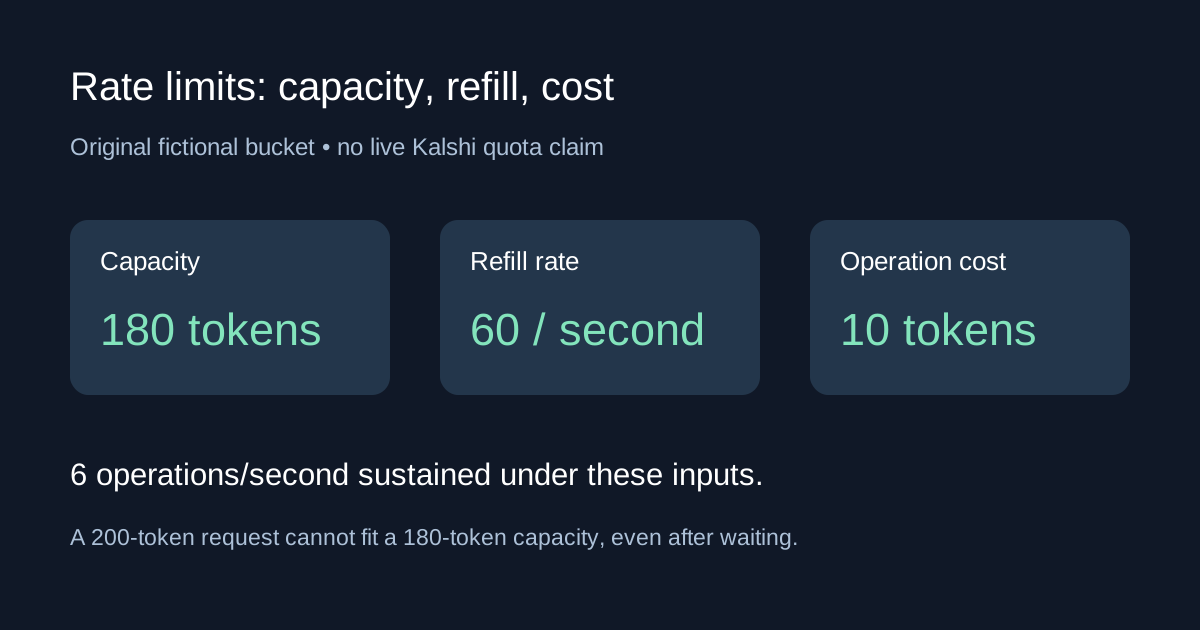
Construct a fictional bucket refilling at 60 tokens per second. If each operation costs 10, its budget supports 60 ÷10 =6 per second over a long enough interval. If an operation costs 20, that falls to 60 ÷20 =3. None of these numbers is a quoted Kalshi tier.
For a mixed workload, add token demand. Three operations costing 10 each plus one costing 20 consume 50 tokens. That leaves 10 of the fictional second’s 60-token refill for other work, provided timing and available balance permit admission. Counting “four requests” alone misses the cost mix.
Burst capacity is different from refill rate
Kalshi’s limits reference says operations select buckets, REST/FIX can share them, and HTTP method alone does not identify the bucket. Check current scope before combining clients.
In our original model, choose a capacity of 180 tokens and a refill of 60 per second, initially full. The bucket can cover 18 hypothetical 10-token operations immediately, even though the sustained arithmetic rate is six per second. After depletion, idle time restores budget only up to 180.
For elapsed time dt, the model first computes available = min(capacity, previous_balance +refill ×dt). It admits a requested cost only if the available balance covers it. An admitted action deducts that cost. A rejected action leaves the balance unchanged in this lesson.
Original token-bucket ledger
Use the fictional 60-refill, 180-capacity bucket. Each row is an attempted budget admission, not a live Kalshi API call or a financial transaction. The model assumes rejected attempts do not consume tokens; actual failed-request accounting must be checked against service rules.
| Elapsed time | Balance before attempt | Requested cost | Model decision | Balance after attempt |
|---|---|---|---|---|
| 0 seconds | 180 | 150 | Admit | 30 |
| 0.25 seconds | 30 +15 =45 | 50 | Reject: short by 5 | 45 |
| 0.50 seconds | 45 +15 =60 | 50 | Admit | 10 |
| 4.00 seconds | min(180, 10 +210) =180 | 200 | Cannot fit even when full | 180 |
At 0.25 seconds, the time required to earn the missing five tokens is 5 ÷60 =0.083333… seconds, if nothing else consumes the bucket. That differs from the (180 −45) ÷60 =2.25 seconds needed to become completely full.
A request costing 200 can never fit the model’s 180 capacity. Waiting longer does not solve that mismatch. The last row also shows capped accumulation: the uncapped balance would reach 220, but 40 tokens of potential refill cannot be banked beyond capacity.
Download the original offline Python simulation. Run python3 kalshi-token-bucket-lesson.py to reproduce the ledger. It uses exact rational arithmetic and simulated timestamps, with no networking, credentials, sleeps or orders.
Read rate-limit headers in their stated units
The official reference defines X-RateLimit-Limit as token capacity, X-RateLimit-Remaining as remaining tokens, X-RateLimit-Reset as seconds until full, and X-RateLimit-Cost as charged cost. Some responses omit counters, and publicly cacheable market-data responses carry no rate-limit headers.
The units matter. In our constructed row at 0.25 seconds, “2.25 seconds until full” is a different calculation from “about 0.0833 seconds until this 50-token attempt could fit.” Neither hypothetical interval is a real server instruction, especially if another worker shares the bucket.
Do not turn a missing header into an invented zero balance, unlimited quota or a guarantee of free capacity. Log what was observed and leave unavailable values unknown.
What does a Kalshi 429 mean?
The limits reference recommends backoff for 429 responses, which lack Retry-After. Batch items retain their costs; other limits can also produce 429.
A troubleshooting record should identify the operation, environment, error body, relevant bucket fields and concurrent application activity. Repeatedly sending the same oversized batch is a different problem from briefly outrunning refill. One needs a request-shape review; the other needs scheduling and workload review.
A rejected admission is not a successfully executed instruction. Separately, transport uncertainty after sending a state-changing instruction should not be treated as proof of rejection. Reconcile the actual order or operation state before any application retries that could duplicate intent.
Multiple workers can share one bottleneck
In another original model, let three workers each plan 30 tokens per second against one shared 60-token refill. Their combined demand is 90, exceeding refill by 30 per second. Each worker’s own 30-token plan looks modest, but their sum is infeasible indefinitely without reducing demand or changing the supplied budget.
Starting with 180 saved tokens only delays depletion under a smooth continuous approximation: 180 ÷(90 −60) =6 seconds. That is not an exact first-rejection time for discrete requests. Scheduling, request sizes and initial timing determine when an actual attempt fails.
Centralized budget accounting can make the combined plan visible. A higher tier, a second protocol client or a new process should not be assumed to create independent capacity without checking the service’s actual scope.
Keep Predictions, Perps and streaming constraints separate
The reference separates Perps budgets, dedicated buckets and WebSocket constraints. A Predictions response does not describe every service.
Our Kalshi WebSocket guide covers authenticated streaming sessions and state recovery. A connection limit, connection-opening cadence, book sequence gap and REST token shortfall are distinct observations, even if an application encounters several during one outage.
A practical rate-limit investigation
- Identify the exact product, lane, account and operation.
- Read the current bucket refill and capacity.
- Resolve default and non-default endpoint costs.
- Record actual error bodies and any available header values.
- Combine demand from workers and other shared clients.
- Separate temporary depletion from a request larger than capacity.
- Reconcile uncertain state-changing outcomes before retrying.
- Test scheduling logic offline before making live throughput claims.
Alphascope’s market-linked news supplies event context for research workflows. That context does not expand API quotas or certify a client’s operational reliability.