
On this page
Kalshi Perps fees depend on the applicable account route, asset category, volume tier and whether a fill adds or removes liquidity. They are calculated on trade notional, not just the collateral posted. Opening and closing a position can each incur a fee; funding is another ledger item.
This guide checks the official fee page as of November 21, 2026 and uses original hypothetical arithmetic. No account, order or transfer was created. Perpetual price exposure is distinct from a binary event contract, so do not copy the event-contract fee formula into a Perps calculation.
Current Kalshi Perps fee schedules: identify the route
The live Invest fee page has separate Kalshi Prime and Self-Clearing tabs. It describes Prime as applicable to most website/app Invest users. Its category selector further distinguishes Base rates, Crypto, Energy, Index, Metals and Stocks.
At the checked Base rates selection, the first three displayed tiers were:
| 30-day trailing volume tier | Prime taker | Prime maker | Self-clearing taker | Self-clearing maker |
|---|---|---|---|---|
| Below $100,000 | 0.120% /12 bps | 0.020% /2 bps | 0.040% /4 bps | 0.020% /2 bps |
| At least $100,000, below $1 million | 0.100% /10 bps | 0.015% /1.5 bps | 0.030% /3 bps | 0.015% /1.5 bps |
| At least $1 million, below $10 million | 0.060% /6 bps | 0.012% /1.2 bps | 0.025% /2.5 bps | 0.012% /1.2 bps |
The page counts trailing Invest plus prediction notional volume, including maker and taker activity. These are dated Base-rate observations, not a promise about every instrument, account or future trade. Use the current selected schedule and category for the actual account route. A lower self-clearing rate is not evidence that a retail Prime account qualifies for it.
Convert basis points before multiplying
One basis point is 0.01 percentage points, or a decimal rate of 0.0001. Therefore 12 bps =0.120% =0.0012, while 4 bps =0.040% =0.0004. A fee calculation needs the decimal rate, not the displayed percentage number.
For a fictional $10,000 fill at an applicable 12 bps rate, the fee is $10,000 ×0.0012 =$12. At an applicable 2 bps rate, it is $10,000 ×0.0002 =$2. Entering 0.12 as the multiplier would mean 12%, not 0.12%.
Kalshi’s Perps fee explanation says the relevant base is the full leveraged notional rather than margin. It also distinguishes immediate taker fills from resting maker fills and says fees apply on both the opening and closing trades. A limit price alone does not establish that a fill earns maker treatment.
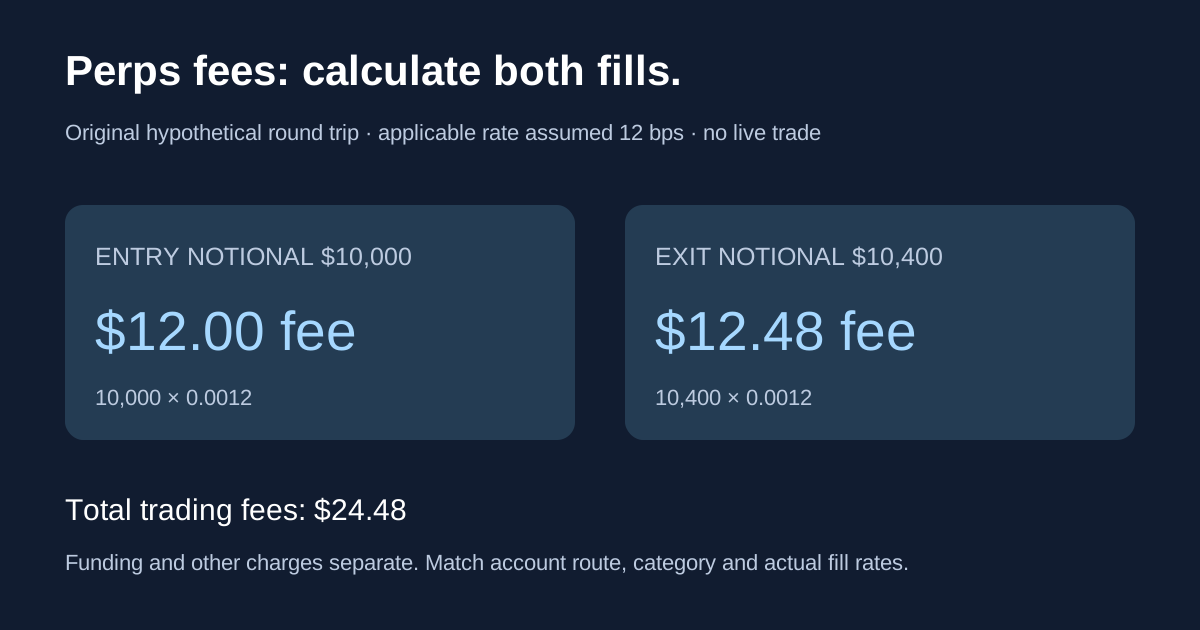
Original round-trip example: opening and closing notionals differ
Assume a fictional long of 0.10 units in a price-tracking contract. Use an entry price of $100,000 per unit and exit price of $104,000. Assume the applicable taker rate remains 12 bps on both fills. These are invented prices and quantities; confirm the actual instrument’s quantity and contract specification before applying a formula.
| Item | Calculation | Amount |
|---|---|---|
| Entry notional | 0.10 ×$100,000 | $10,000 |
| Entry fee | $10,000 ×0.0012 | $12.00 |
| Exit notional | 0.10 ×$104,000 | $10,400 |
| Exit fee | $10,400 ×0.0012 | $12.48 |
| Total trading fees | $12.00 +$12.48 | $24.48 |
| Gross price PnL | 0.10 ×($104,000 −$100,000) | $400.00 |
| Assumed net funding paid | Stipulated cost, not a quoted rate | $3.00 |
| Result after those costs | $400.00 −$24.48 −$3.00 | $372.52 |
The closing fee is not necessarily the opening fee again: the exit notional in this example is larger. Doubling $12 would understate the stated round trip by $0.48. If price or quantity changes differently, recompute each fill separately.
The $372.52 result excludes other applicable charges and assumes the displayed entry and exit were actually obtained. It is not a live return, a forecast or an executable quote. Spread and slippage affect the prices used; liquidation can introduce a different exit and additional costs.
Maker vs taker: compare costs without inventing fills
As a separate counterfactual, assume the same entry and exit prices, quantities and $3 funding cost but a 2 bps maker rate on both fills. The stipulated fees become $10,000 ×0.0002 =$2.00 and $10,400 ×0.0002 =$2.08, totaling $4.08.
That produces $400 −$4.08 −$3 =$392.92 under the assumptions, $20.40 more than the taker example. It is a mathematical comparison, not evidence that a resting order would fill at the same time, size or price as an immediate order.
An order can involve several execution records. Preserve actual maker/taker classification per fill rather than inferring the total from the button clicked. For why the circumstances of a fill matter, see adverse selection; for order lifetimes, see time in force.
Why a small rate can look large relative to margin
Hold the fictional entry notional fixed at $10,000 and its entry fee fixed at $12. Now compare three hypothetical collateral amounts:
| Collateral | Notional/collateral ratio | $12 entry fee as a share of collateral |
|---|---|---|
| $2,000 | 5x | 0.6% |
| $1,000 | 10x | 1.2% |
| $500 | 20x | 2.4% |
The notional and dollar fee did not change in this comparison. The denominator changed. Conversely, holding collateral fixed while increasing exposure can increase the fee because the notional becomes larger. These ratios are illustrative arithmetic, not a claim that every instrument allows the stated leverage or collateral.
In the original taker round trip, $24.48 total trading fees equal 2.448% of hypothetical $1,000 initial collateral. That is not the per-fill rate, an annualized rate or the underlying asset’s return. Keep the denominator beside every percentage.
Funding is separate from trading fees
The official help article distinguishes funding payments from trading fees and says an open position may pay or receive funding. Preserve the actual realized funding entries rather than treating them as a guaranteed constant debit or income stream.
Our ledger assumes a net $3 payment only to show the accounting. If funding were instead a net $3 receipt under otherwise identical assumptions, the result would be $400 −$24.48 +$3 =$378.52. The $6 difference comes from switching a $3 debit to a $3 credit.
Why the source version and customer route matter
The generic fee PDF available during this review carried a July 7, 2026 effective label and a different Perps tier layout. The live Invest page displayed the route-specific tables summarized above. Do not mix an old PDF’s thresholds with the live page’s rates.
An October 19 Kalshi filing hosted by the CFTC describes separate self-clearing and FCM schedules and implementation on or after October 30. It says exchange charges in its FCM section are assessed against the FCM member, and FCMs remain free to set customer commissions and fees. A filed exchange schedule is therefore not automatically the complete customer bill for every broker route.
For a real estimate, save the active fee-page selection, applicable account classification and trade preview. For an actual completed fill, use the trade details and ledger record. If displayed sources conflict, seek clarification from the official provider instead of silently choosing the lowest number.
A Kalshi Perps fee worksheet
- Identify the exact instrument, quantity units and customer route.
- Record the selected fee category, tier and observation date.
- Convert basis points or percent into a decimal multiplier.
- Compute each fill’s notional and fee separately, including the close.
- Reconcile maker/taker classification and any additional broker charges.
- Track funding, spread effects and other costs separately.
- Distinguish estimates from actual executed prices and ledger entries.
Download the original worked fee ledger and blank fields. For event-contract costs, use our existing Kalshi prediction-market fees guide; its price-based contract formula serves a different product.
Our Polymarket Perps guide provides a separate product’s collateral and funding example. Do not use either venue’s rates or eligibility rules as a substitute for the other’s. Alphascope’s market research adds context, not a guaranteed trading outcome.