
On this page
Polymarket Perps are perpetual contracts that track an underlying asset rather than resolving a Yes/No event. A long or short position changes value as the reference market moves, with collateral, funding and liquidation rules. A $0/$1 prediction-market share and a leveraged perpetual position are different products.
This is a documentation-based guide checked November 21, 2026, with an original fictional account ledger. It is not a hands-on trading test or a claim that every reader can access the product. The official Perps FAQ says order placement is not permitted from the United States, Canada and other listed restricted jurisdictions. Review the current full list and terms for the actual product; a public page or API document does not establish account eligibility.
What are Polymarket Perps?
The official overview describes contracts tracking underlyings such as equities, indices, commodities or crypto assets. They have no expiry and can remain open until closed or liquidated. Index Price tracks the underlying reference; Mark Price is used for account equity, margin checks and liquidation risk.
“No expiry” does not mean “no ongoing cost” or “no forced exit.” Funding and margin can affect the position while it remains open. A current product list and its instrument settings are more useful than assuming one fixed leverage limit applies everywhere.
Perps vs Polymarket prediction markets
| Question | Event contract | Perpetual position |
|---|---|---|
| What is being expressed? | A specified event outcome under written resolution rules | Long or short price exposure to a tracked underlying |
| How is the result determined? | The contract’s outcome and payout rules | Price movement, position changes, funding, costs and margin state |
| Does the position await a Yes/No decision? | A held event share can await resolution | No event-resolution finish line supplies the ordinary trade PnL |
| What should you inspect? | Outcome definition, source, deadline and executable price | Instrument specification, Mark, margin mode, funding and effective fees |
For event outcomes, see our resolution-disputes guide. Do not apply its UMA challenge clock to a perpetual position, or treat a Perps price as a binary probability.
Last trade, Index and Mark are different inputs
The Perps FAQ distinguishes the last executed trade from Index and Mark, and says the last trade is not the margining price. It also explains that order matching and risk checks continue when the underlying reference market is outside regular hours; the feed set used for pricing can change.
As a fictional diagnostic, suppose the last trade reads 95 while the relevant Mark is 94. A risk worksheet that substitutes 95 has changed its input. Preserve the exact field and observation time rather than calling both values simply “the price.” This example does not describe a real market quote or the system’s pricing algorithm.
Original ledger: notional is not the collateral balance
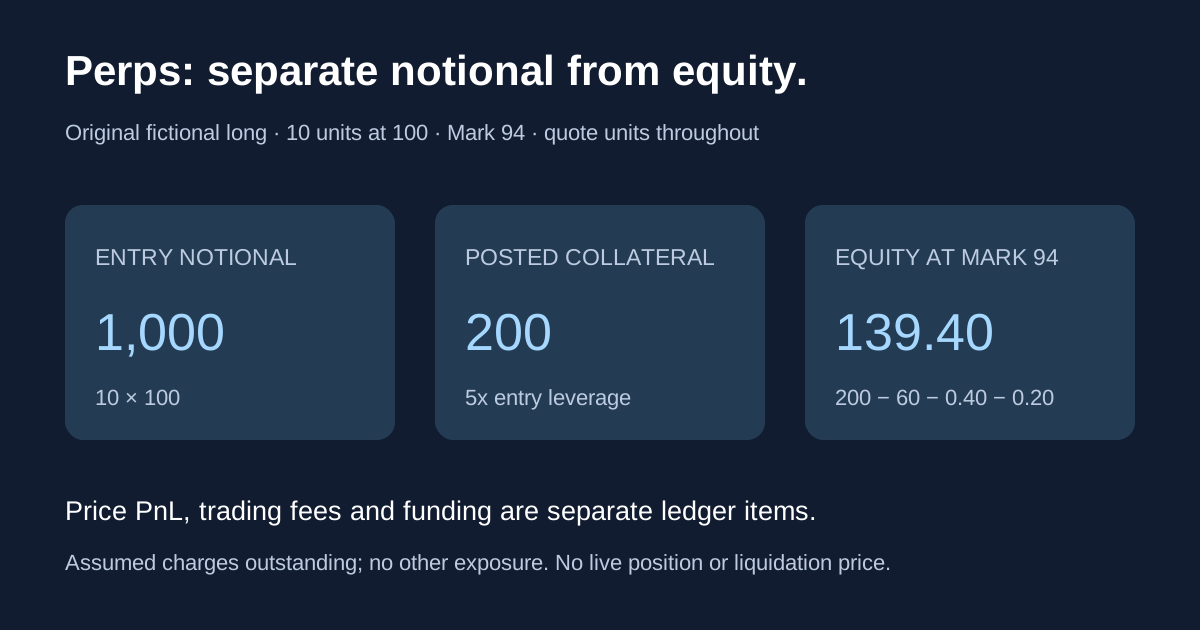
Assume a fictional long position of 10 units entered at 100 quote units per unit. Let posted collateral be 200 quote units and configured leverage be 5x. The position’s entry notional is 10 ×100 =1,000; initial margin at entry under notional ÷leverage is 1,000 ÷5 =200.
For this illustration only, assume an applicable 0.04% entry trading fee and one funding debit of 0.20 quote units. The fee is 1,000 ×0.0004 =0.40. Assume those charges are outstanding and excluded from the stated 200 collateral balance, so they must be subtracted once. There are no other positions, resting orders, costs, transfers or realized gains.
| Ledger item | Stipulated calculation at Mark 94 | Quote units |
|---|---|---|
| Entry notional | 10 ×100 | 1,000 |
| Current notional | 10 ×94 | 940 |
| Unrealized long PnL | 10 ×(94 −100) | −60 |
| Entry trading fee due | 1,000 ×0.04% | 0.40 |
| Funding due | Assumed debit | 0.20 |
| Equity | 200 −60 −0.40 −0.20 | 139.40 |
The price change is −6%, while the equity decline relative to the original collateral is (139.40 −200) ÷200 =−30.3%. Those percentages use different denominators. The collateral did not make the underlying move by 30.3%.
The official margin page defines equity using collateral, unrealized Mark-based PnL and outstanding fees/funding. It gives long PnL as size times Mark minus entry. If a real account’s displayed balance already includes a settled charge, subtracting that charge again would double-count it. Reconcile the actual ledger before using an equation.
Initial margin and maintenance margin answer different questions
The same margin documentation distinguishes entry requirements from the minimum to maintain exposure. It states a per-market maintenance rate of 0.5 ÷market maximum leverage, separate from the trader’s configured leverage, and describes cross and isolated collateral scopes.
Extend the fictional ledger by stipulating that this market’s maximum leverage is 20x and that its rate and settings remain unchanged. The maintenance rate is then 0.5 ÷20 =0.025 =2.5%. At Mark 94, maintenance margin is 940 ×2.5% =23.50, while initial margin at configured 5x is 940 ÷5 =188.
Our stipulated equity of 139.40 is below 188 but above 23.50. The FAQ’s state table classifies equity between maintenance and initial margin as margin call/reduce-only, and equity below maintenance as liquidation. Being below the entry requirement is therefore not the same numerical test as being below maintenance.
This simplified comparison does not calculate a live liquidation price, account for a cross portfolio, or guarantee an exit fill. A liquidation order’s executed price and charges are separate from the threshold calculation. For the broader concepts, read maintenance margin and notional value.
Funding payments are separate from price PnL
The current funding guide describes premium sampling and hourly settlement. A positive hourly rate means longs pay shorts; a negative rate reverses the direction. Funding is tracked separately from trading PnL and can continue across market sessions.
In a separate constructed example, assume an applied settlement notional of 1,000 quote units and a positive hourly rate of 0.02%. The stipulated payment is 1,000 ×0.0002 =0.20. A long pays that amount; a short receives it under those assumptions. This supplies the assumed debit in the ledger, not a current published funding rate.
Do not automatically treat a displayed eight-hour or implied rate as the actual hourly debit. The official guide describes averaging and conversion before settlement. Preserve the rate’s period, sign, relevant size basis and realized charge. One assumed hour does not establish a constant annual yield.
Current fees and scheduled November 25 changes
As checked November 21, the official standard fee schedule lists 0.0400% taker and 0.0125% maker fees at the lowest volume tier. It calculates exchange fees on each fill’s absolute notional in pUSD. Effective account rates, overrides and separate builder fees can change the actual cost.
The official upcoming-changes notice schedules a lowest-tier taker rate of 0.0500% and maker rate of 0.0200% for November 25, 2026. It says current rules apply until the change goes live. The notice also schedules liquidation-fee and liquidity-reward changes. These are scheduled terms, not a claim they are already effective.
| One hypothetical 10,000 pUSD fill | Standard lowest tier checked Nov 21 | Scheduled Nov 25 rates if effective |
|---|---|---|
| Taker | 10,000 ×0.0400% =4.00 pUSD | 10,000 ×0.0500% =5.00 pUSD |
| Maker | 10,000 ×0.0125% =1.25 pUSD | 10,000 ×0.0200% =2.00 pUSD |
Those calculations concern one fill only. Closing a position can generate another fee on the close’s actual notional. Funding, spread, slippage and applicable extra charges remain separate. Read the live effective rate when estimating a real order rather than freezing a dated article’s table into an integration.
For a separate venue and fee route, see Kalshi Perps fees: Prime vs self-clearing. Its dated examples distinguish customer schedules and opening/closing notionals; the rates are not interchangeable with Polymarket’s.
A Perps research checklist
- Verify eligibility for the actual product and jurisdiction.
- Identify the instrument, units, quote asset and current reference fields.
- Separate position notional from posted collateral and account equity.
- Record configured leverage, market maximum and margin mode.
- Track fees and funding once in the ledger, with their timing and status.
- Distinguish a risk threshold from an executed liquidation or closing trade.
- Check whether dated changes are scheduled or already effective.
Download the original fictional Perps ledger. It reproduces the arithmetic and provides blank research fields. No order, account funding, collateral transfer or financial transaction was performed for this guide.
Alphascope’s market-linked research can provide event context. That context is separate from a perpetual instrument’s pricing and margin mechanics, and does not establish access, execution quality or profitable trades.