
On this page
The Polymarket Builders Program supports applications that route users’ orders through Polymarket. A builder code connects eligible matched activity to a builder profile. It is different from a reader following a referral link, an API response arriving successfully or a grant being approved.
This documentation-based guide was checked November 21, 2026. It covers the international Builder Program, not a claim of Polymarket US access or Alphascope’s membership. For the program itself, use the official builders portal. We have not created a profile, generated credentials or placed trades for this article.
What is the Polymarket Builders Program?
The official program overview describes integrations that route orders, attach a builder code and receive attribution on matching trades. It lists relayer access, volume tracking, leaderboard visibility and support, with benefits depending on status.
Reading public market data is a different workflow. A research dashboard can fetch a price without routing a user order. That request alone does not demonstrate attributed trading volume. Start with our Polymarket API guide for discovery and data access, then evaluate the separate program requirements if your product actually routes orders.
Builder code vs API key vs referral link
| Item | Purpose in this discussion | What it does not prove |
|---|---|---|
| Builder code | Identifies a registered builder in the order-attribution workflow | That the order matched or rewards were approved |
| Trading authentication | Authenticates the applicable account request and signing flow | That builder attribution was attached correctly |
| Relayer credential | Authorizes the supported relayer operations | Unlimited access to every API or product |
| Referral link | Belongs to a separate referral workflow | That a signed order carries a builder code |
The current order-placement reference includes a builder field in signed order data. The current fee reference identifies the registered code as a bytes32 value. Do not infer that adding an arbitrary analytics parameter to a URL modifies a signed order.
For an integration review, record the actual SDK version, market protocol, signing route and attribution field. Keep credential material out of public examples. Older examples using different builder headers or SDKs should be reconciled with the current supported flow rather than mixed into a new implementation.
A matched fill is different from an accepted order
The program overview credits matched trades carrying the builder code and says leaderboard updates can take up to 24 hours. The order-placement reference distinguishes a resting accepted order from an immediately matched one. An accepted response therefore cannot, by itself, establish matched volume or a leaderboard credit.
Design an evidence chain: application action, submitted order identity, observed execution, builder identity on the relevant record, and credited program record. Preserve timestamps and data-source scope. An application log saying “submitted” and an onchain settlement record are different observations.
Original attribution ledger: avoid counting a retry twice
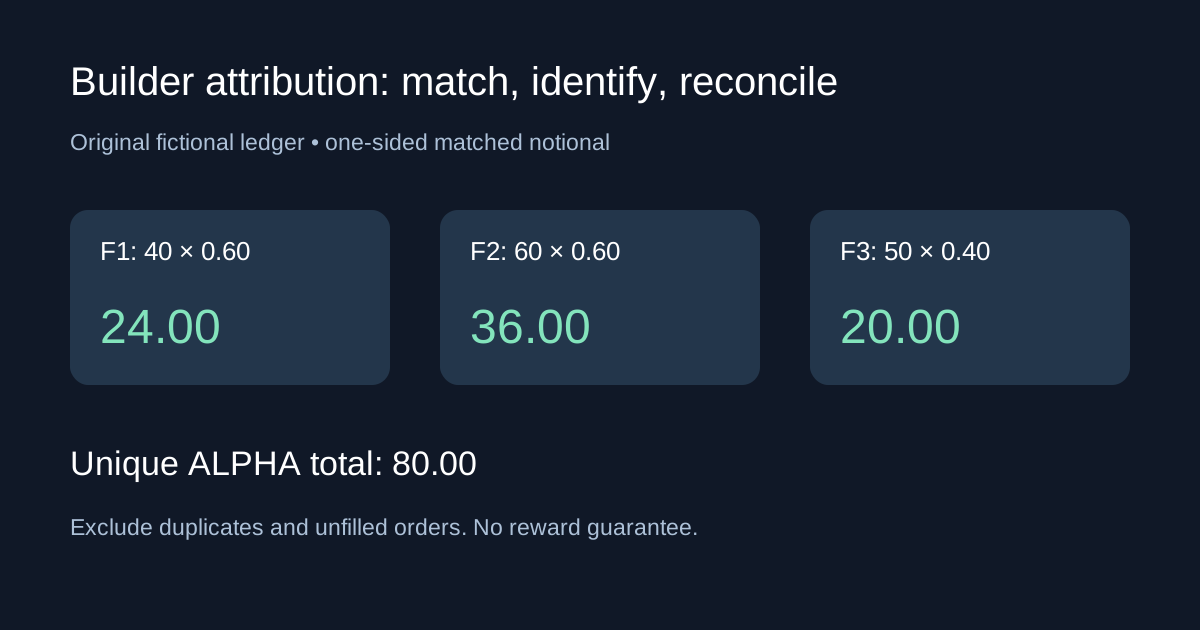
Consider this deliberately invented dataset for builder ALPHA. The identifiers and statuses below are teaching labels, not a Polymarket API schema. Assume the three rows labeled eligible are valid third-party matches carrying ALPHA. All prices are quote units per share, with no fees included.
| Record | Quantity × price | Observation | Included notional in this lesson |
|---|---|---|---|
| Fill F1 | 40 ×0.60 | Eligible unique match | 24.00 |
| F1 repeated | 40 ×0.60 | Duplicate delivery of F1 | 0.00 additional |
| Fill F2 | 60 ×0.60 | Eligible unique match | 36.00 |
| Fill F3 | 50 ×0.40 | Eligible unique match | 20.00 |
| Order O4 | 100 ×0.50 | Accepted, unfilled | 0.00 matched |
| Order O5 | 100 ×0.50 | Rejected | 0.00 matched |
| Fill F6 | 20 ×0.50 | Different builder BETA | 0.00 for ALPHA |
The lesson’s ALPHA total is 24 +36 +20 =80.00. Counting F1’s duplicate would inflate it to 104.00. Adding unfilled or rejected order instructions would inflate it further without adding eligible matched activity.
This is a one-sided integration ledger, not a definition of an official aggregate-volume metric. It does not imply both sides should be added or that this fictional amount qualifies for a reward. Real reconciliation needs the protocol’s identifiers, settlement status, corrections and program eligibility rules.
Download the original attribution worksheet. Use it to define deduplication and exclusion rules before comparing your own logs with a program dashboard.
Builder fees are separate from platform fees and rewards
The official builder-fee guide describes a fee on matched notional that adds to any applicable platform fee. It lists default builder rates of zero and current maximums of 100 basis points for takers and 50 for makers. Current profile settings, market rules and the order side matter.
In a separate fictional example, assume a 400.00 quote-unit matched notional and a configured builder rate of 25 basis points. The builder component is 400 ×25 ÷10,000 =1.00. If the independently stipulated platform component is 0.80, the combined fee is 1.80.
The 0.80 is an assumed amount, not the platform’s actual formula or a live quote. Spread, slippage and other applicable charges are not modeled. A user-facing total should expose the components that actually apply instead of advertising a builder rate as the entire transaction cost.
The fee guide describes separate maker and taker configuration, delayed rate changes and daily payouts subject to a minimum. An accrued fee, a cash payout and a program reward are different records. Do not convert a hypothetical matched-volume calculation into promised revenue.
Tiers, relayer limits and verification
The current tier table lists Unverified, Verified and Partner statuses. Daily relayer allowances are 100, 10,000 and unlimited respectively; that table separately labels non-relayer API limits. A daily relayer allowance is not a requests-per-second allowance for every endpoint.
The tier documentation requires manual approval for Verified status and marks grants and weekly rewards as approval-dependent. Its feature table shows builder fees across tiers, while a later Verified section also lists monetization as an unlock. That wording should be confirmed against the actual profile and program team before treating a tier label as permission to charge.
For an original capacity-planning illustration, suppose an integration expects 70 supported operations and reserves a budget of 20 additional attempts under a simplified model where each consumes one daily unit. Planned use is 90, leaving 10 against a hypothetical 100-unit allowance. This does not establish how a real relayer accounts for failures, retries or batching. Inspect actual responses and usage rather than assuming every HTTP request consumes one unit.
Do all Polymarket builders receive grants?
No automatic award is established by the documentation. Program access, an attributed trade, verification, leaderboard visibility, a fee entitlement and a grant approval should be tracked separately. A business plan should distinguish confirmed terms from hoped-for incentives.
The public portal discusses grants and weekly rewards, but a dated article should not invent award amounts, a current pool or a guaranteed approval timeline. Check the active terms and the project’s confirmed status before budgeting incentive income.
Attribution requires genuine third-party activity
The program’s Code of Conduct, updated October 30, 2026, requires clear fee disclosure and accurate statements about builder status. It excludes trades made on Polymarket.com from builder attribution and prohibits artificial volume, wash trading and gaming rewards. It also requires compliance controls and forbids bypassing restrictions.
Those requirements are material to a measurement plan: a perfectly deduplicated record can still be ineligible. Our invented ledger explicitly assumes eligibility for its three included matches; arithmetic cannot prove that assumption in a real dataset.
A practical Builder Program review
- Identify the actual product and official program, including access restrictions.
- Define whether your application reads data, routes orders or both.
- Record the current registered code, SDK and supported signing flow.
- Separate request acceptance, matching, settlement and program credit.
- Deduplicate executions using the correct source identifiers and scope.
- Verify fee components and disclose applicable customer costs.
- Track relayer capacity separately from other API limits.
- Require confirmed status and terms before claiming grants or rewards.
For market context alongside integration research, use Alphascope’s market-linked news. Neither research content nor this independent explainer establishes an official partnership, trading eligibility or program approval.