
On this page
PredictIt charges 10% of profit on a profitable share sale, rather than 10% of the entire sale value. Its September 23, 2026 update removed the old 5% withdrawal charge for ACH and check withdrawals. The current FAQ qualifies free standard withdrawals as applying to active accounts. Check the current account-specific schedule before moving funds.
Checked November 21, 2026 against PredictIt’s fee update, How to Trade page and official FAQ response. This guide uses invented transactions to explain the arithmetic; it does not report live fills or provide tax advice.
PredictIt fee structure: separate trading, deposits and withdrawals
| Cost | Current official description | What to check |
|---|---|---|
| Profitable sale | 10% of the profit | Purchase cost and realized sale proceeds |
| Sale at purchase price or below | No profit fee | Losses still reduce your balance |
| ACH deposit | Free | Availability and funding conditions |
| Credit card deposit | 3%, with a limited fee waiver | Your remaining waiver eligibility and checkout total |
| Standard withdrawal | Free from active accounts | Account status, method and current terms |
The announcement describes one fee-free next card deposit up to $1,000; the FAQ calls it a first-deposit waiver. Do not assume repeated waivers or free processing above that limit. Confirm your own offer before depositing. See PredictIt’s terms for account conditions. A zero standard withdrawal charge does not settle the treatment of inactive accounts.
How to calculate the 10% profit fee
For a hypothetical single purchase lot sold in full, let C be its purchase cost and S its gross sale proceeds. The arithmetic model is:
Gross profit = S − C
Profit fee = 0.10 × max(S − C, 0)
Net sale proceeds = S − profit fee
Net trading result = S − profit fee − C
This isolates the stated profit fee. It assumes an executable purchase and sale at the stipulated prices and ignores deposit costs, taxes and other account charges. It is not a claim about PredictIt’s lot-selection or cent-rounding policy for mixed purchases and partial sales. Use the actual statement for those details.
| 100-share example | Purchase cost | Gross proceeds | Profit fee | Net trading result |
|---|---|---|---|---|
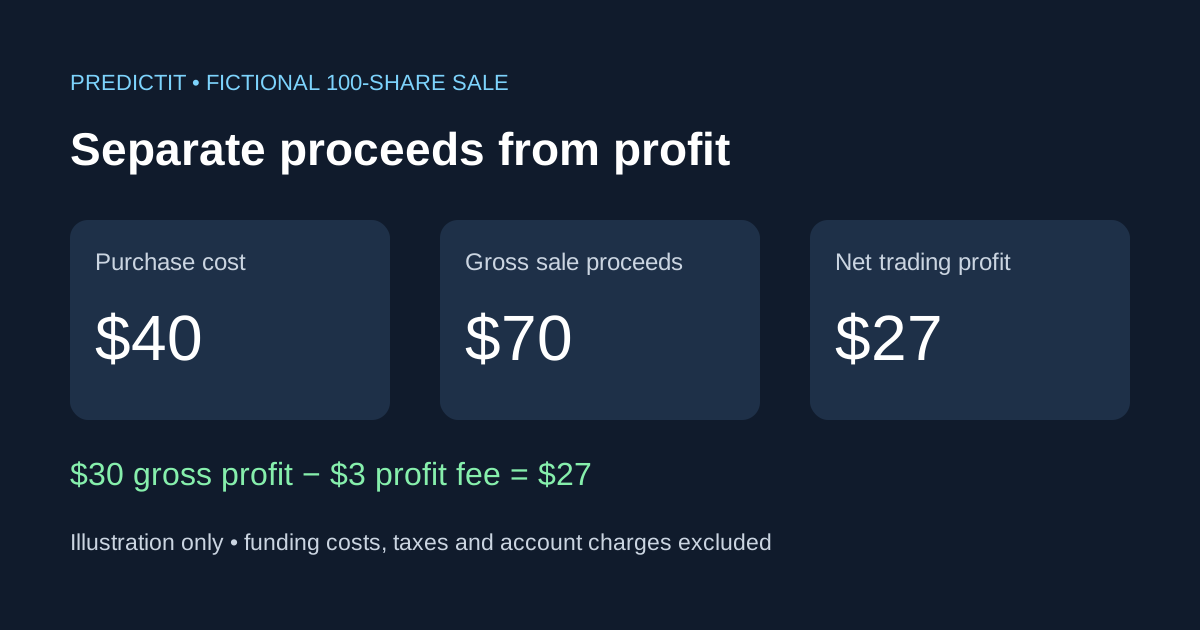
| Buy at $0.40, sell at $0.70 | $40 | $70 | $3 | +$27 |
| Buy at $0.40, sell at $0.40 | $40 | $40 | $0 | $0 |
| Buy at $0.40, sell at $0.20 | $40 | $20 | $0 | −$20 |
In the first row, $70 is sale proceeds, $30 is gross profit and $27 is profit after the $3 trading charge. Taking 10% of $70 would incorrectly charge $7 in this example. Calling $67 of net sale proceeds “profit” would also be wrong: $40 of that amount recovers the original purchase cost.
A winning trade and a losing trade do not cancel their fees
Consider two independent, fictional trades. Trade A costs $40 and sells for $70; Trade B costs $40 and sells for $20. Before fees, their combined gain is $10. Applying the profitable-sale fee to A produces $3 of charges, leaving a combined $7 gain.
Charging 10% of the combined $10 would produce $1 and overstate the result by $2. That shortcut changes a transaction-level charge into a portfolio-level charge. Our example follows the FAQ’s profitable-sale description; it does not assume that a loss generates a fee rebate.
Does PredictIt still have a withdrawal fee?
The previous 5% schedule is historical for standard active-account withdrawals. To see the difference, imagine withdrawing the first example’s full $67 net sale proceeds. Under a hypothetical additional 5% deduction, the cash received would be $63.65. Under a zero standard withdrawal charge, it would remain $67, before any separate applicable conditions.
The difference is $3.35, not $1.35: a withdrawal percentage applies to the withdrawn amount in that hypothetical comparison, which includes recovered capital. Do not subtract both the old charge and the current zero charge in the same estimate. Nor does “free” mean funds become immediately withdrawable; fee amount and withdrawal availability are separate questions.
Card funding can erase a small trading gain
Assume a separate $100 card deposit attracts a $3 processing charge in addition to the deposit, with no waiver. The total cash outlay is $103. If a subsequent hypothetical trade turns the $100 purchase cost into $102 of sale proceeds, its $2 profit incurs a $0.20 profit fee. The resulting $101.80 is $1.20 below the initial $103 outlay.
This example stipulates how the funding charge is paid; it does not describe every checkout’s presentation. Read the actual deposit confirmation to distinguish money credited from total money charged. For an eligible waived deposit, remove that assumed $3 cost rather than carrying it into the calculation.
Break-even probability after a profit fee
A conditional model helps explain why price alone is not a complete break-even calculation. Suppose a binary share costs p, pays $1 if it wins and $0 if it loses, and a 10% charge applies to its positive settlement profit. Assume no other costs and no early exit. A win returns 1 − 0.10(1 − p), while a loss returns zero.
Break-even win probability q = p / (0.90 + 0.10p)
At p = 0.40: q = 0.40 / 0.94 = 42.5532…%
The threshold exceeds 40% under those assumptions. This is a mathematical scenario, not a forecast, a claim that the displayed price is a calibrated probability, or a guarantee of the precise accounting on a real settlement. Actual rules, rounding, funding costs and execution can change the cash result. Our expected value calculator can help with separate hypothetical payoff scenarios; confirm its inputs and supported cost assumptions.
Download the worked fee ledger
The plain-text worksheet records every input and cash-flow distinction above. Reconcile purchase cost, gross proceeds, profit fee, net proceeds and funding charges as separate entries. For a price comparison across venues, compare identical contract rules and executable size as well as fees. Read our basis risk guide before treating similarly named markets as interchangeable.
For data-field interpretation, see PredictIt API data and usage terms. For research across prediction markets, Alphascope provides market analysis; this article does not claim a PredictIt trading integration or place orders.