
On this page
Polymarket negative risk connects outcome positions within a qualifying multi-outcome event. Under the documented conversion, one No position on an outcome becomes one Yes position on each of the other outcomes. The name describes a position mechanism; it does not mean a purchase cannot lose money.
This independent guide was checked November 21, 2026 against Polymarket’s negative-risk documentation. It concerns the international prediction-market product, not Polymarket US or perpetual futures. All prices, sizes and cost allowances below are fictional. No wallet was connected, conversion submitted or arbitrage opportunity observed.
Negative risk explained with three possible winners
Consider a hypothetical event with exactly three possible winners: A, B and C. The outcomes are mutually exclusive and collectively exhaustive: precisely one wins, and the list contains every possibility. Assume each winning Yes token pays one collateral unit and each losing Yes token pays zero.
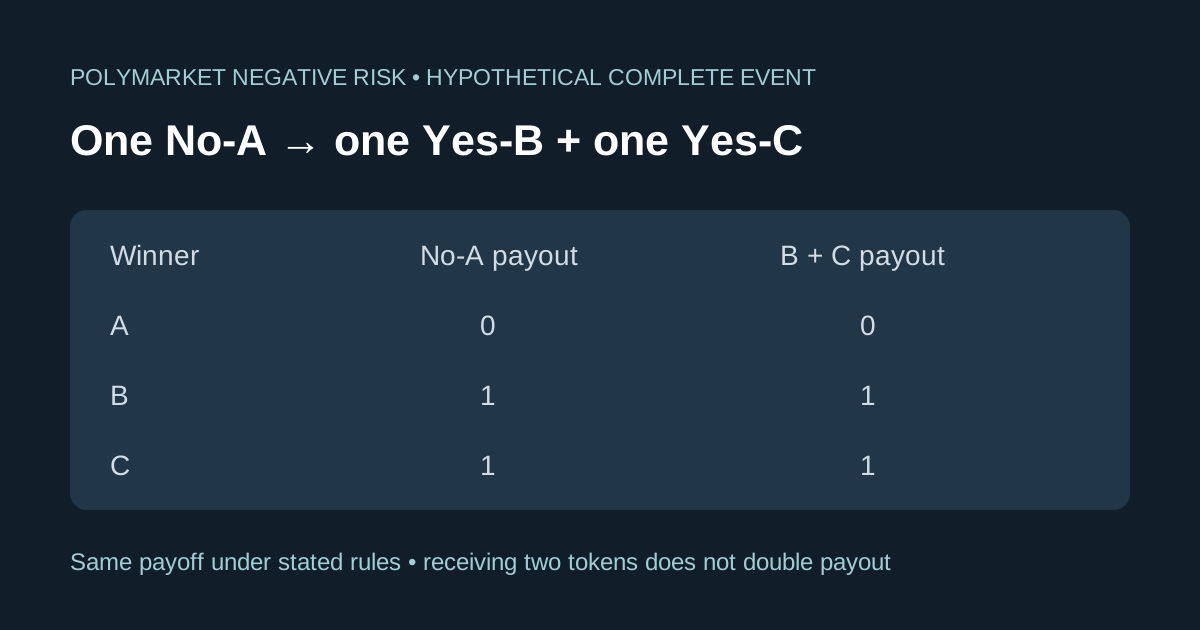
A No position on A pays zero if A wins and one if either B or C wins. A basket containing one Yes on B and one Yes on C has the same payoff in all three permitted states:
| Winner | One No on A | One Yes on B | One Yes on C | B + C basket |
|---|---|---|---|---|
| A | 0 | 0 | 0 | 0 |
| B | 1 | 1 | 0 | 1 |
| C | 1 | 0 | 1 | 1 |
Receiving two tokens does not double the final payout: at most one of those two Yes outcomes wins. Converting 100 No-A positions into 100 Yes-B and 100 Yes-C positions preserves this hypothetical payoff vector: 0, 100, 100. It changes inventory composition, not the event’s possible winners.
This is an OR-style payoff across the other mutually exclusive outcomes. It is different from a combinatorial Yes position, which represents a conjunction of legs. Buying several Yes tokens does not by itself create a new combined token.
When the apparent equivalence fails
The truth table depends on its assumptions. If there is an omitted possible winner D, No-A can pay one when D wins while a basket of only B and C pays zero. If B and C can both win, that basket can pay two while No-A pays only one. Neither collection has the same payoff as No-A in every state.
That is why similarly worded markets cannot be grouped just because their prices look complementary. Confirm the exact event membership, payout rules and supported conversion mechanism. A collection of unrelated binary questions is not automatically a negative-risk event. See basis risk for why near-matching questions can still have different cash outcomes.
How to evaluate Polymarket negative-risk arbitrage
Start with a hypothetical, fully executable price comparison. Suppose 100 No-A positions can be purchased at 0.58 each and converted into 100 Yes-B plus 100 Yes-C. Assume all 100 B tokens can then be sold at 0.36 and all 100 C tokens at 0.25. Prices here are in collateral units per position.
No-A purchase: 100 × 0.58 = 58
B sale proceeds: 100 × 0.36 = 36
C sale proceeds: 100 × 0.25 = 25
Gross difference: 36 + 25 − 58 = 3
Stipulated total cost allowance: 1
Illustrative net difference: 3 − 1 = 2
The allowance of one unit is invented for the example, not Polymarket’s current fee schedule. Replace it with the actual costs of the proposed sequence, including applicable trading, conversion, funding or execution costs. A cost total of three units erases the entire gross difference; a total of four produces a one-unit loss.
This is a conditional cash-flow calculation. A positive result requires the specified quantities and prices to execute, the conversion to be supported for the actual positions, and total costs to stay within the allowance. It does not establish that those conditions exist in any live market.
A top quote is not enough: the smallest leg limits size
Now change only the available size. B has 100 units available at the stipulated bid, but C has only 40. At those prices, a complete two-leg exit is limited to 40 units, assuming the entry also supports that quantity.
For those 40 complete units, purchase cost is 23.20, sale proceeds are 14.40 + 10.00 = 24.40, and the gross difference is 1.20. With a separately stipulated 0.40 total cost, the net is 0.80. The 0.40 is an example assumption, not a promise that real costs scale linearly.
The next C order-book level might be worse or absent. Do not multiply a top bid by 100 when only 40 units are shown there. The slippage calculator can illustrate consuming successive hypothetical price levels; it does not fetch or execute this conversion.
Partial execution leaves a directional position
Suppose someone instead buys and converts all 100 No-A positions, sells all 100 B positions for 36, and sells only 40 C positions for 10. Cash sale proceeds are now 46, and 60 Yes-C positions remain. With the same stipulated total cost of one unit:
| Final winner | Remaining C payout | Total net result |
|---|---|---|
| A | 0 | 46 − 58 − 1 = −13 |
| B | 0 | 46 − 58 − 1 = −13 |
| C | 60 | 46 + 60 − 58 − 1 = +47 |
The remaining inventory makes the result depend on C winning. This is no longer the fully closed two-unit difference from the earlier example. A quote changing between steps, a rejection or an unfilled leg can create this kind of exposure.
The official negative-risk page describes the conversion itself as atomic. That does not establish that a separate purchase, conversion and multiple order-book sales execute together at fixed prices. Distinguish a single position operation from the entire multi-step trading plan.
Augmented negative risk and “Other”
Polymarket also documents augmented negative risk: named outcomes coexist with additional outcomes and an explicit Other category. Its guidance says to use named outcomes, ignore unnamed placeholders until named or resolved, and avoid directly trading Other because its definition changes as outcomes are clarified. Read the current augmented-event rules rather than assuming a visible list is permanently complete.
For a payoff worksheet, store the membership and definitions with the observation time. If an outcome list changes, recompute the basket instead of reusing an old count or label. A locally complete list for an earlier snapshot is not proof that it remains the complete event today.
CTF and Protocol V2 are separate integration paths
The current migration plan schedules the first Protocol V2 trading phase for November 23, 2026, after this guide’s review date. It says existing CTF markets retain their contracts and holdings. A published future rollout is not evidence that every market has already migrated.
Documentation distinguishes CTF’s negative-risk adapter from Protocol V2’s Router and NegRiskModule. Preserve the market’s position system and compatible identifiers rather than copying an old contract address into every workflow. See the official position-management reference for supported operations. Current examples use pUSD; this guide does not submit transactions or verify a particular account’s permissions.
Download the payoff and cash-flow checks
The offline Python worksheet uses exact fractions to check the three-outcome identity, complete exits, the 40-unit size limit and the partial-fill results. It also demonstrates the missing-outcome and overlapping-outcome counterexamples. It uses invented inputs, needs no packages and has no network or signing functions.
Keep event/market/outcome identity, observation time, position-system version, executable depth, completed amounts, residual tokens and costs in separate records. Reconcile actual confirmations before calling a position closed. For the surrounding data workflow, read our Polymarket API guide and order-book API guide. Explore Alphascope for prediction-market research; no negative-risk execution integration is claimed here.