
On this page
Ambiguity aversion is a preference for a prospect with better-specified probabilities over a comparable prospect whose probabilities are unclear. It concerns the information supporting the probabilities, rather than simply the possibility of a bad outcome. A person can dislike a well-understood risk, an ambiguously assessed prospect, or both.
What does ambiguity aversion mean?
In Daniel Ellsberg’s 1961 paper, choices between prospects with different information challenge a single subjective-probability account. His discussion treats information quality and confidence in probability judgments as relevant, not just the quantity of information.
The distinction does not imply that every reluctance to participate is ambiguity aversion. Different rewards, misunderstood instructions or account constraints can change a decision. A useful example holds those other features constant.
An adapted Ellsberg example
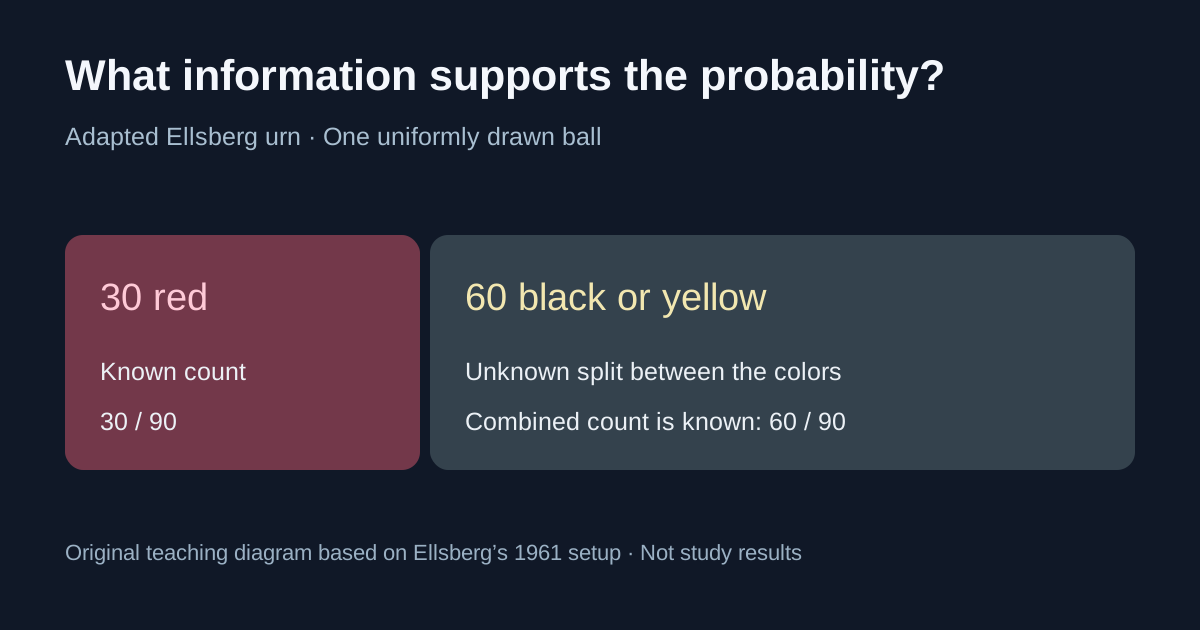
Adapted from Ellsberg: an urn has 30 red balls and 60 balls split between black and yellow in unknown proportions. One ball is drawn uniformly. The following teaching table uses a $25 prize instead of the original monetary prize. Each row is a separate possible choice, not a portfolio.
| Choice | If red | If black | If yellow |
|---|---|---|---|
| A: red | $25 | $0 | $0 |
| B: black | $0 | $25 | $0 |
| C: red or yellow | $25 | $0 | $25 |
| D: black or yellow | $0 | $25 | $25 |
The paired preference A over B and D over C favors known proportions: red is one third; black-or-yellow is two thirds. Black’s proportion and red-or-yellow’s proportion are unknown. This is the classic pattern to analyze, not a claim that everyone chooses it.
Why the paired preferences challenge one probability model
Let r, b and y be one set of subjective probabilities for the three mutually exclusive colors, summing to 1. Assume the same increasing utility for the $25 and $0 outcomes across all choices.
Strictly preferring A to B requires r >b. Strictly preferring D to C requires b +y >r +y, hence b >r. Both inequalities cannot hold for that same probability vector. Changing the common yellow payoff from zero to $25 should not reverse the ordering under this setup.
This is a statement about what the stipulated preference pattern is compatible with. It does not identify the true black-yellow composition, assign probabilities to the missing composition, or measure how often people exhibit the pattern.
Ambiguity aversion versus risk aversion
Risk aversion is commonly illustrated by preferring a certain amount to a risky payoff with the same expected money value. Ambiguity aversion asks how the quality of probability information affects preferences between prospects.
In the paired-color calculation, all four options use the same two payoffs. Allowing a nonlinear utility function does not remove the contradiction under a single shared probability vector: the positive difference between utility of $25 and utility of $0 multiplies both comparisons and cancels. Thus “the person dislikes risk” alone does not explain this particular pattern within the stated model.
| Question | What to examine |
|---|---|
| Does the person dislike outcome variation? | Risk preferences, holding probability information clear |
| Does uncertain probability information affect the choice? | Information and ambiguity preferences, holding payoffs comparable |
| Does the person understand the outcome being offered? | Question wording and comprehension before interpreting either preference |
Is ambiguity aversion necessarily irrational?
A conflict with the stated model’s assumptions is precise evidence about that model’s ability to represent the choices. It is not a complete assessment of a person’s reasoning in every setting. The paper itself separates describing such behavior from settling its normative merit.
In practice, first check whether the comparison really held everything else constant. If one choice has uncertain payment reliability, different fees or an unclear outcome definition, those are additional features to analyze. A preference involving those features is not automatically the same controlled comparison as the urn exercise.
How to use the distinction in prediction-market research
For a Kalshi or Polymarket question, distinguish uncertainty about the world from uncertainty about the contract. “Will a policy change?” requires evidence about the policy. “Does an announcement count, or must the change take effect?” requires reading the resolution rules.
Our epistemic-uncertainty guide explains uncertainty about models and parameters. Ambiguity aversion concerns preferences toward uncertain probability information; the two ideas are related but answer different questions.
A displayed price cannot diagnose ambiguity aversion on its own. Participants may have different information, constraints or objectives. Record the exact contract, timestamp, quote type and available quantity before explaining a price difference with a psychological label.
An original ambiguity audit for a research file
Suppose you compare two fictional sources for the same event. Source A provides a dated estimate, a defined sample and a clear method. Source B provides an equally precise number but no method or provenance. You can investigate that evidence gap without pretending to have measured either source’s true accuracy.
- Target: Are both sources forecasting the same event and deadline?
- Evidence: What observations support each estimate?
- Method: Is the calculation documented and reproducible?
- Missing information: What relevant facts remain unavailable?
- Disagreement: Do sources disagree about facts, models or definitions?
- Decision: Which missing item would change your assessment?
More decimals do not answer these questions. Neither does repeatedly copying one estimate. Preserve the distinction between a number you can calculate and the information needed to trust its application.
Reduce an information gap before assigning a label
Write down the uncertainty in plain language: a missing fact, an unknown parameter, a disputed source or an unclear rule. Then identify the next check that could resolve it. If you lack enough evidence to quantify the uncertainty, say so rather than forcing a probability or a diagnosis of bias.
For comparing complete product and contract records, use our decision worksheet. Alphascope’s market news can support source gathering, while the exact rules and primary evidence remain the basis for a defined forecast.