
On this page
A funding rate in crypto perpetual futures determines a periodic payment between long and short positions. A positive applied rate generally means longs pay shorts; a negative rate reverses that direction. It is a carrying-cost input and a clue about pricing pressure, not a stand-alone forecast of the next price move.
This guide explains funding-rate meaning with original fictional calculations. It separates the displayed rate, the actual settlement, position notional and price PnL. It does not report current funding rates or a tested trading strategy.
What does a funding rate mean?
A perpetual contract has no scheduled expiration that automatically brings its price and a spot reference together. Funding creates an economic incentive related to that gap. For the specific implementation, read Hyperliquid’s funding documentation: payments are between holders, settle hourly and use a formula with both premium and interest components.
Distinguish three things: the premium observed in the market, the rate produced by the funding formula, and the cash amount applied to a position. They have different units. A premium is not itself a dollar debit, and a funding rate is not the position’s return.
| Field | Question it answers | Common mistake |
|---|---|---|
| Premium | How does the relevant perpetual pricing compare with its reference? | Assuming every venue uses the last trade |
| Funding rate | What proportion applies for the stated period? | Reading an eight-hour figure as hourly |
| Payment | How much is paid or received at settlement? | Multiplying by posted collateral instead of the required size basis |
| Price PnL | What did the position gain or lose from price changes? | Calling a funding receipt total profit |
Funding payment calculation: use the correct notional
For a simplified linear, quote-settled teaching model, define positive notional N and signed applied period rate r. The long’s funding cash flow is −N × r; the equal-sized short’s is +N × r. Positive cash flow means a receipt. This sign convention is for our worksheet; a platform may display a positive “funding paid” debit instead.
Assume a long position of 0.2 underlying units, a stipulated funding reference price of 50,000 quote units and an applied hourly rate of +0.02%. Notional is 0.2 × 50,000 = 10,000, the rate as a decimal is 0.0002, and the long pays 10,000 × 0.0002 = 2.00. The matching short receives 2.00 in this model.
Posted collateral of 2,000 would make that payment 0.1% of the original collateral. It would not change the 2.00 payment for the unchanged notional and rate. Dividing by collateral describes a different ratio from the funding rate. See notional value and collateral allocation for those distinctions.
For a real contract, verify the multiplier, settlement currency and valuation basis. Hyperliquid’s documentation specifically uses its spot oracle to convert position size to funding notional, rather than Mark. Do not substitute a convenient chart price or apply this linear equation to an inverse contract without its actual rules.
What does a negative funding rate mean?
In the same model, replace the rate with −0.01% and keep notional at 10,000. The long’s cash flow becomes −10,000 × (−0.0001) = +1.00. The short pays 1.00. This is a reversal in the payment direction, not a promise that either position will earn a positive total return.
A reader seeking a “crypto signal” should distinguish an observation from a prediction. A negative applied rate describes the funding terms for that interval. It does not logically establish that the underlying asset must rise afterward. The opposite inference from positive funding is equally incomplete.
Original example: three settlements with changing rates
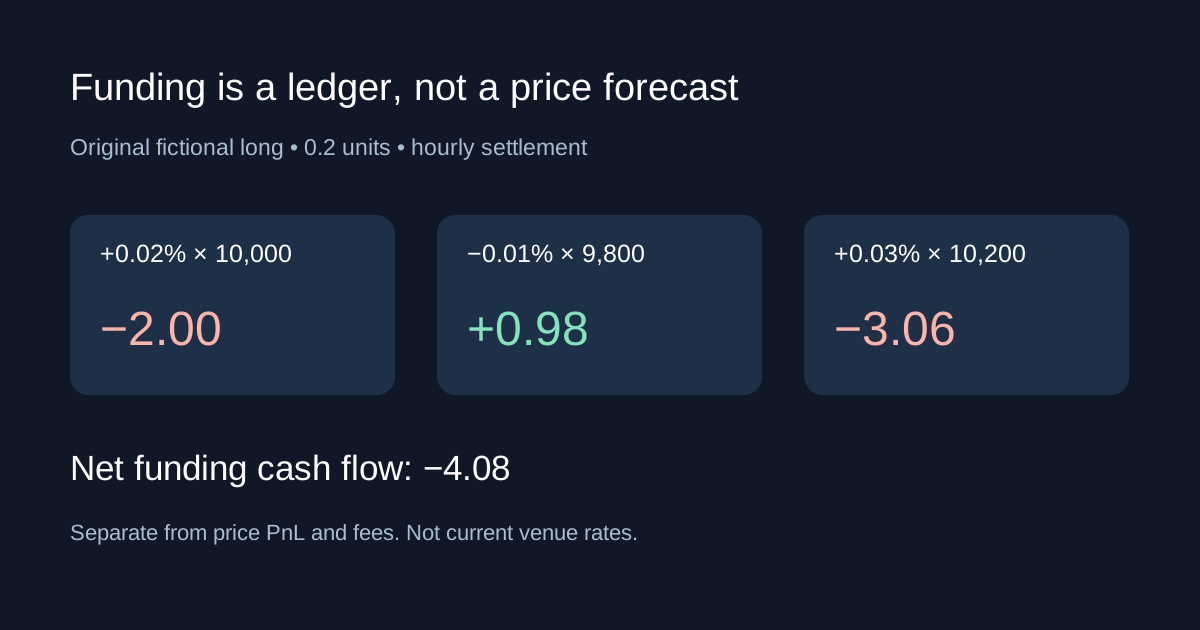
Now construct a separate three-hour record. Keep size at 0.2 units, and stipulate the following reference prices and applied rates at each settlement. Assume the position is eligible at all three settlements, has no size changes and survives throughout. Ignore price-PnL cash settlement, fees, transfers and other account activity for this funding-only table.
| Settlement | Reference price | Notional | Applied hourly rate | Long cash flow |
|---|---|---|---|---|
| 1 | 50,000 | 10,000 | +0.02% | −2.00 |
| 2 | 49,000 | 9,800 | −0.01% | +0.98 |
| 3 | 51,000 | 10,200 | +0.03% | −3.06 |
| Total | Different each hour | Different each hour | Do not simply multiply the last rate | −4.08 |
The equal-sized opposite position receives a net 4.08 under the model. Holding the first notional fixed for all three rows would instead produce a 4.00 debit. That 0.08 discrepancy comes from ignoring the changing valuation basis. Multiplying only the final rate by three would be a different and larger mistake.
Download the original settlement ledger and blank research fields. Preserve each settlement’s applied rate and notional instead of reconstructing an entire holding period from one current screen.
Funding received does not mean the trade was profitable
In an independent one-interval example, a long enters 0.2 units at 50,000 and exits at 49,000. Gross linear price PnL is 0.2 × (49,000 −50,000) = −200. Stipulate a negative funding settlement that credits 1.00 and total opening/closing fees of 4.00. Net result is −200 +1 −4 = −203.
The funding receipt cushions the loss by 1.00; it does not reverse it. Likewise, someone paying funding could still have positive total PnL if favorable price gains exceed the payment and all other costs. The funding sign alone cannot classify the whole trade.
Hourly vs eight-hour funding rates
Every rate needs a period. A hypothetical +0.08% rate for eight hours corresponds to +0.01% per hour under a simple equal division assumption. On a fixed 10,000 notional, eight identical hourly charges would total 8.00. Charging +0.08% every hour would total 64.00 over eight hours, eight times as much.
This arithmetic is a normalization example, not a guarantee that the rate will stay unchanged. Hyperliquid documents an eight-hour formula whose result is divided by eight for hourly payments. Its current documentation also distinguishes HIP-3 premium construction and configurable funding behavior. A generic chart should not erase instrument-specific rules.
A displayed estimate can change before settlement. An annualized display extrapolates a period rate under chosen assumptions; it does not establish a locked annual yield. Record whether a figure is estimated, applied, historical, annualized or accumulated, and whether it uses a changing notional.
How to read funding as a crypto-market signal
Funding can help describe demand for leveraged exposure and the cost of maintaining it. It cannot identify all motivations behind a position: an open short may offset spot holdings, another derivative or inventory. Payment direction does not reveal a trader’s complete portfolio or private forecast.
To evaluate a predictive claim, specify the exchange and instrument, signal timestamp, information actually available then, price horizon and transaction costs. Compare outcomes with an appropriate baseline over independent periods. Avoid using a final settled rate as if it were known earlier. A backtest that ignores that timing can manufacture apparent foresight.
For event-market research, a perpetual funding rate is also not a Yes/No outcome probability. A positive 0.02% funding rate does not imply a 0.02% chance of an event. Contract mechanics, rate periods and probability estimates answer different questions. Alphascope’s market-linked news can help investigate event context while these quantities remain separate.
Polymarket Perps funding: a dated implementation example
Polymarket’s funding guide, checked November 21, 2026, describes five-second premium sampling, averaging over an hour, conversion from an eight-hour formula and hourly settlement. It distinguishes crypto and non-crypto scaling, and keeps realized funding separate from trading PnL.
Its documentation describes a transfer between opposing positions without a protocol cut. A rolling implied rate between settlements is not the same record as the amount ultimately applied. Read the current instrument and account ledger when reconciling payments; none of the hypothetical rates in this article are live Polymarket quotes.
Our Polymarket Perps overview separately covers product access, collateral, fees and maintenance requirements. Funding is only one part of those mechanics, and reading public documentation does not establish eligibility to trade.
A funding-rate research checklist
- Identify the venue, instrument, contract units and settlement currency.
- Record the rate’s period and whether it is estimated or applied.
- Check who pays under the platform’s sign convention.
- Use the specified reference and size basis for each settlement.
- Preserve the actual payments rather than assuming one constant rate.
- Reconcile price PnL, fees and funding separately, counting each once.
- Test any predictive claim with information available before the outcome.
Funding is useful when read as a defined mechanism and a dated market observation. The actual ledger, not the rate’s label or sign alone, determines what was paid and how it affected the result.