
On this page
Cross margin allows eligible positions to share collateral within a defined account scope. Isolated margin assigns collateral to a particular position or instrument. The difference is where the loss buffer comes from and which equity is assessed, not whether a price move produces profit or loss.
The exact scope depends on the venue, account configuration and instrument. This guide uses an original fictional ledger to explain the distinction. It is not a trading test, a platform ranking or a guarantee about maximum losses.
Cross margin vs isolated margin
| Question | Cross | Isolated |
|---|---|---|
| What backs exposure? | Shared eligible collateral within the applicable scope | Collateral allocated to that position or instrument |
| Can another position’s equity matter? | Yes, where it participates in the shared calculation | Not automatically as part of the isolated allocation |
| What must be identified? | Eligible balances, included positions, collateral rules and obligations | Allocated margin, extra transfers, top-up settings and instrument rules |
| Is one always more profitable? | No | No |
Hyperliquid’s margin documentation describes shared cross collateral and an isolated asset allocation. It also shows why “cross” is not synonymous with every asset everywhere: the included scope depends on account abstraction and, in some configurations, DEX and collateral identity.
Use the actual account’s eligible collateral and risk scope. Do not add unrelated wallet balances to a margin calculation merely because they appear under the same login.
Original example: 500 total collateral, two allocations
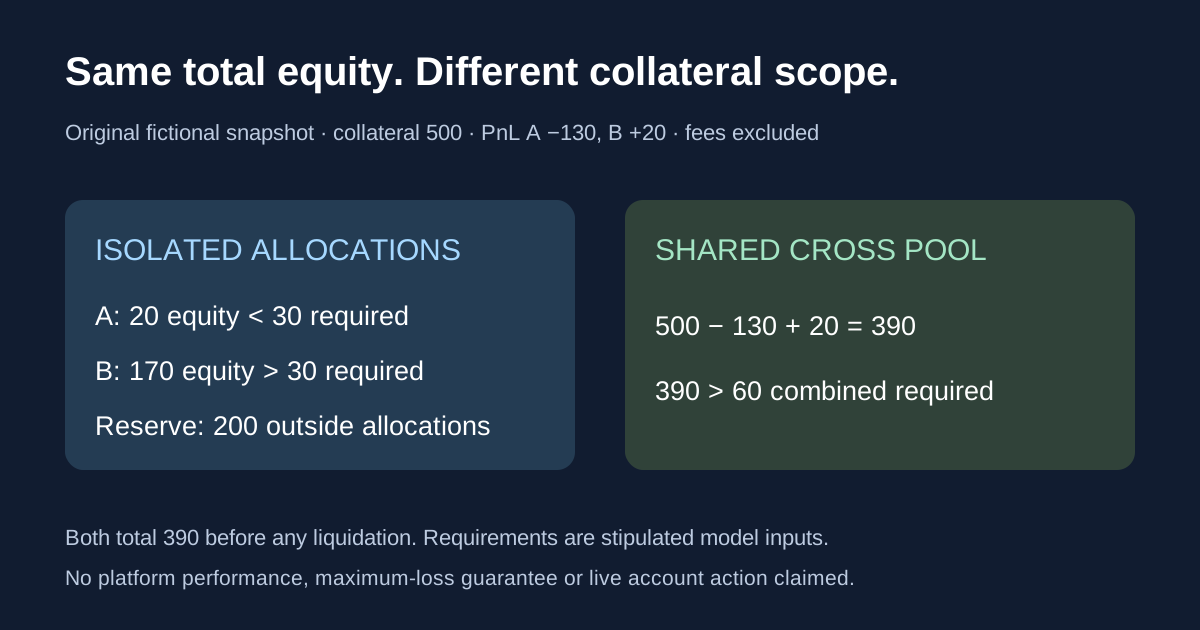
Construct two independent counterfactual configurations of the same fictional starting resources. Both have 500 quote units of collateral and the same two positions, A and B. For the isolated run, assign 150 to A, 150 to B and leave 200 outside both allocations. For the cross run, all 500 are eligible shared collateral.
At one stipulated pre-liquidation assessment snapshot, A has unrealized PnL of −130 and B has +20. For this toy example, maintenance requirements at that snapshot are 30 for A and 30 for B. Assume valid entry requirements were satisfied beforehand. Ignore fees, funding, pending orders, collateral haircuts and all other activity.
These maintenance amounts are supplied model inputs, not rates quoted from an actual exchange. This is a snapshot comparison, not a simulated path after a real liquidation has already happened.
| Assessment | Equity calculation | Equity | Stipulated maintenance requirement | Snapshot result |
|---|---|---|---|---|
| Isolated A | 150 −130 | 20 | 30 | Below its requirement |
| Isolated B | 150 +20 | 170 | 30 | Above its requirement |
| Unallocated isolated-run reserve | 200 | 200 | Not backing A or B in this model | Does not automatically cure A |
| Cross pool | 500 −130 +20 | 390 | 30 +30 =60 | Above combined requirement |
Across the isolated run’s allocations and reserve, total marked equity is 20 +170 +200 =390. The cross run also has 390. The PnL did not improve merely because the mode changed. The difference is that A is assessed against its allocated 20 in one configuration, while eligible shared equity supports the combined scope in the other.
The cross configuration therefore avoids the stipulated maintenance breach at this snapshot. That does not make it universally safer: additional shared resources are now available to support losses. A common collateral pool can transmit the effect of one position’s losses to other exposure inside that scope.
Adding margin redistributes resources; it does not create equity
As a separate counterfactual allocation made before assessment, move 100 from the fictional reserve into isolated A. A’s collateral becomes 250 and its marked equity becomes 250 −130 =120. B remains at 170, while the reserve falls to 100.
Total marked equity is still 120 +170 +100 =390. A now exceeds the stipulated 30 requirement because more resources back it. The extra 100 is not a profit and does not change the original price PnL. Whether such a transfer is permitted or timely on a real platform is a separate question.
Bybit’s automatic-margin-replenishment documentation provides a concrete venue-specific example: when enabled for supported isolated products, the feature can move available account funds into a position. It also says the feature does not guarantee avoidance of liquidation. Do not assume an “isolated” label alone means the original allocation will never increase.
Maintenance is not the same as the entry requirement
Margin mode defines collateral scope. Initial and maintenance requirements define different thresholds within that scope. A position can have positive equity yet fall below maintenance, as isolated A’s 20 versus 30 illustrates. Comparing equity only with zero would miss that condition.
Our maintenance-margin guide explains threshold concepts. The notional-value guide separates exposure from cash posted. Changing a leverage setting or moving collateral does not automatically alter the underlying position size.
The ledger above intentionally omits initial-margin state after the mark changes, so “above maintenance” should not be relabeled “unrestricted healthy trading.” A venue may apply additional entry, withdrawal or reduce-only requirements.
Keep fees, funding and collateral valuation in the scope
For a sensitivity illustration, add a fee obligation of 4 and funding obligation of 6 to A, assuming neither is already included in collateral. Isolated A’s equity becomes 150 −130 −4 −6 =10. The cross pool becomes 500 −130 +20 −4 −6 =380.
The classification at the supplied maintenance amounts remains unchanged: 10 is below 30, while 380 exceeds 60. But the available buffers are smaller. Subtracting a settled charge twice, or ignoring one still due, produces a different account picture.
If collateral is not valued at one quote unit per unit, a real calculation also needs the venue’s valuation rules. The toy ledger’s fixed cash-like collateral assumption does not cover a collateral asset falling in price alongside the positions it supports.
How the distinction appears in Polymarket Perps
Polymarket’s Perps margin documentation, checked November 21, 2026, describes cross positions backed by shared free collateral and isolated positions backed by their allocation. It provides an equity equation incorporating Mark-based unrealized PnL and outstanding fees and funding.
The same documentation describes instrument-level mode support and configuration defaults. Its current instructions require closing the instrument’s position and canceling its orders before switching between cross and isolated modes. Do not assume switching is a harmless relabeling of an existing live position.
Our Polymarket Perps guide has a separate notional/PnL example and product eligibility discussion. Its rate and instrument settings are not defaults for other exchanges. This article performs no account configuration or trade.
Which mode should a comparison evaluate?
There is no universal winner without a stated objective and actual rules. A comparison concerned with separating one position’s collateral has a different objective from a comparison concerned with sharing eligible equity across multiple positions. Neither objective removes market risk or makes all wallet funds automatically accessible.
- Name the account scope and eligible collateral assets.
- Record each position, allocated margin and relevant unrealized PnL.
- Check initial, maintenance, withdrawal and open-order requirements separately.
- Inspect automatic top-up behavior and any manual transfers.
- Read instrument support and mode-switching restrictions.
- Preserve actual fees, funding and collateral valuations.
- Separate an assessment threshold from the price and costs of an eventual exit.
Download the original allocation ledger and blank comparison fields. The numbers describe a deliberately simplified model, not a liquidation-price estimator. For the cost side of a different venue, see Kalshi Perps fees; its customer routes and rates need their own verification.