
On this page
Being liquidated in crypto generally means a platform forcibly reduces or closes a leveraged position because the relevant equity no longer meets its maintenance requirement. It is different from choosing to sell, and it can happen while the position still has positive equity.
This guide concerns margined perpetual positions. It does not describe every lending protocol, corporate insolvency or sale of spot holdings. The examples are original fictional accounting models, not current exchange prices, account tests or a liquidation calculator for a live position.
What does liquidated mean in crypto?
Opening a leveraged position requires collateral. After entry, changing prices and account obligations affect the equity supporting that exposure. A maintenance requirement defines a minimum risk buffer. If the relevant equity falls below that requirement, the platform’s liquidation process can take control of the affected exposure.
Hyperliquid’s liquidation documentation describes a maintenance-equity test, order-book liquidation and a separate backstop. It also explains that a position’s displayed liquidation estimate can change with funding and, in cross margin, PnL on other positions.
A losing position is not automatically a liquidated one. A voluntary closing trade is not automatically a liquidation. And a headline describing a large amount of liquidated positions does not, by itself, tell you the traders’ original collateral or net cash loss.
Maintenance margin vs zero equity
Use two separate quantities: equity, which includes the relevant collateral and PnL after applicable obligations, and maintenance margin, which is the requirement against which that equity is assessed. A positive balance can be too small for the exposure it supports.
Polymarket’s Perps liquidation guide, checked November 21, 2026, describes liquidation when equity is below maintenance. Cross positions use combined cross equity and maintenance; an isolated position uses its own allocation and requirement. It continuously reassesses the relevant scope as state changes.
Read maintenance margin for the requirement itself and cross vs isolated margin for collateral scope. Those concepts help explain the trigger without promising a particular liquidation outcome.
Original long-position example: positive equity, maintenance breach
Construct a fictional isolated linear long: 100 units entered at 100 quote units, backed by 1,000 collateral. Stipulate a flat maintenance rate of 5% of current notional. Assume valid entry requirements, no fees or funding, fixed size, cash-like collateral and no other activity. The rate is a teaching input, not a quoted venue rule.
At a hypothetical assessment price P, equity is 1,000 +100 ×(P −100). Current notional is 100 ×P, and maintenance is 5% ×100 ×P. We compare independent snapshots before any liquidation execution.
| Assessment price | Unrealized PnL | Equity | Maintenance | Snapshot comparison |
|---|---|---|---|---|
| 100 | 0 | 1,000 | 500 | Above maintenance |
| 95 | −500 | 500 | 475 | Above maintenance |
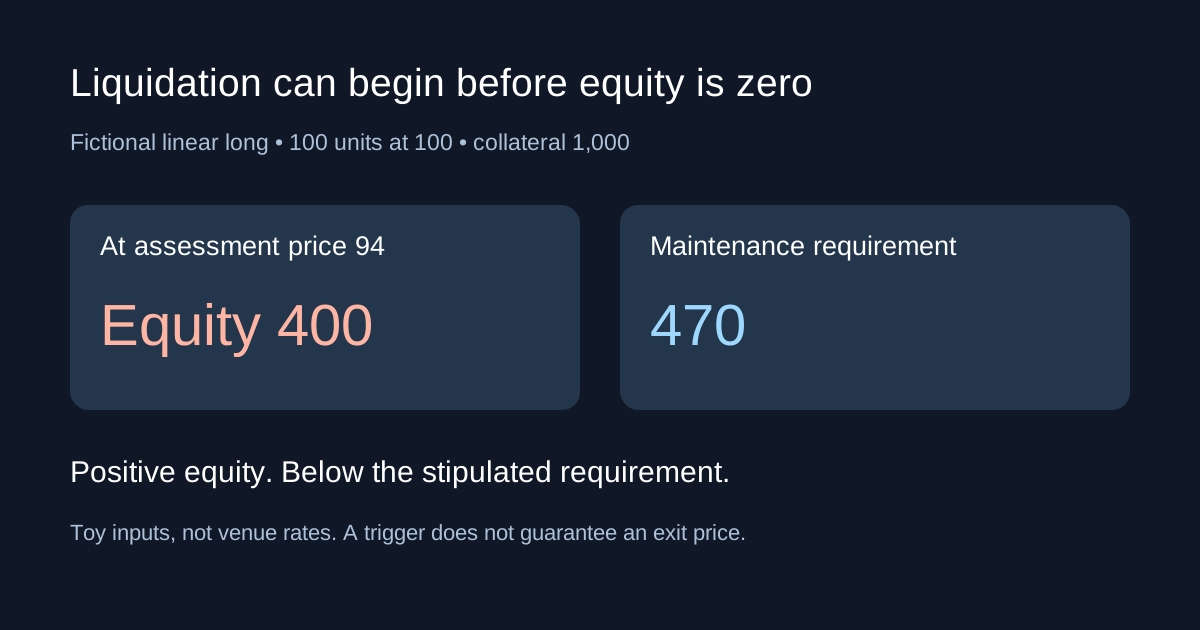
| 94 | −600 | 400 | 470 | Below maintenance despite positive equity |
At 94, the gap to maintenance is 400 −470 =−70. Waiting until the model’s equity reaches zero would miss the maintenance breach. “Above maintenance” also does not establish that new orders or withdrawals satisfy every other requirement.
Liquidation price vs bankruptcy price
In this simplified model, solve the equality between equity and maintenance: 1,000 +100 ×(P −100) =0.05 ×100 ×P. Rearranging gives 95P =9,000, so the boundary is 94.736842….
For the assumed strict-below test, prices below that boundary breach maintenance; equality itself is the boundary, not a modeled forced fill. Separately, solve equity equal to zero: 1,000 +100 ×(P −100) =0. The model’s bankruptcy price is 90.
These prices answer different questions. The first is where the supplied maintenance test reaches equality. The second exhausts the simplified equity. Neither is an actual execution price. A real instrument may have tiered requirements, collateral haircuts, accrued costs, rounding, open-order obligations and other positions that invalidate this toy equation.
Hyperliquid’s documentation specifically notes that margin tiers depend on position value at the liquidation price. That is one reason a single fixed-rate expression should not be copied into a universal exchange calculator.
Why the last traded price may show a different picture
Now stipulate a separate snapshot with a risk assessment price of 94 and a last trade of 96. Applying our toy long’s equation to 94 gives equity 400 and maintenance 470. Substituting the last trade instead would give equity 600 and maintenance 480. That substitution would incorrectly report the position above maintenance if the risk system actually uses the former reference.
Hyperliquid’s robust-price documentation distinguishes its oracle and Mark and assigns Mark to margining and liquidation. Polymarket’s Mark documentation likewise describes a composite risk reference using local and external inputs. Their detailed constructions and update schedules are not interchangeable.
A chart’s last trade, an index, a risk Mark, a best bid and an eventual average fill can differ. Record the field and timestamp before deciding that a liquidation trigger contradicts what a chart shows.
Trigger price is not the guaranteed sale price
Return to the fictional long and stipulate that a liquidation order begins after the 94 assessment. In an invented execution, all 100 units sell at an average 93.50, with a total additional closing charge of 20. Assume no other changes.
Realized price PnL becomes 100 ×(93.50 −100) =−650. Remaining collateral after that loss and charge is 1,000 −650 −20 =330. This is 70 less than the 400 equity in the earlier 94 snapshot: 50 from the lower sale price and 20 from the charge.
The 20 charge is a supplied example cost, not an exchange fee rate. The calculation neither guarantees returned collateral nor caps a real liquidation loss. It simply separates the assessment from the later cash result.
Polymarket’s current guide describes reduce-only immediate-or-cancel liquidation orders that interact with available liquidity, alongside insurance-fund and auto-deleveraging paths for more severe conditions. It also warns of scheduled fee changes on November 25. The route and current charges must be checked independently; a trigger alone does not establish the executed result.
Can a short position be liquidated too?
Yes. In a separate fictional short with the same 100-unit size, entry of 100, collateral of 1,000 and flat 5% maintenance rate, equity is 1,000 +100 ×(100 −P). Price increases now create losses.
The equality is 11,000 −100P =5P, giving P =11,000 ÷105 =104.761904…. At 105, equity is 500 while maintenance is 525, so the stipulated short breaches maintenance. Its separate zero-equity price is 110.
This is an independent counterfactual position, not a claim that simultaneously holding this long and short creates two independently assessed real accounts. Netting, hedged modes and portfolio scope depend on the venue.
Why a liquidation estimate can move
Even without changing entry price, a calculation can change if eligible collateral, outstanding charges, position size, maintenance tiers or the PnL of other included positions changes. Funding payments are one ledger input; the relevant amount must be counted once rather than subtracted again after settlement.
As a separate before-assessment allocation choice in our fictional long, add 100 eligible collateral. At price 94, equity would be 500 rather than 400, above the stipulated 470 maintenance. The new equality boundary becomes (10,000 −1,100) ÷95 =93.684210…. The price PnL at 94 remains −600: extra collateral changes the buffer, not the original loss.
This counterfactual assumes the resources were available and assigned beforehand. It does not show that a transfer submitted during an actual liquidation will arrive in time or be accepted.
Reading crypto-liquidation headlines
When a report gives “liquidations” in dollars, check its method before treating the figure as investor losses. Does it measure closed notional, original margin, a count of orders or another quantity? Which exchanges and products are included? Does it cover confirmed executions or estimated liquidation levels?
A notional amount is not an interchangeable measure of cash lost. In our fictional full exit at 93.50, closed notional is 9,350, price loss is 650, the stipulated charge is 20 and remaining collateral is 330. Those four amounts all describe the same constructed event from different perspectives.
For event-linked context, browse Alphascope’s market news. Keep news interpretation separate from a position’s actual liquidation ledger or a Yes/No event contract’s resolution.
What to check in a liquidation record
- Identify the actual product, position units and margin scope.
- Record collateral, accrued obligations and all included PnL.
- Use the risk reference and maintenance rules in force at the time.
- Distinguish a displayed estimate, a threshold breach and an execution.
- Reconcile size reductions, average fill, charges and any transfers.
- Identify a backstop or auto-deleveraging record separately where relevant.
- State exactly what any reported dollar total measures.
Download the original long/short ledger and blank evidence fields. For a product-specific introduction, see Polymarket Perps; public documentation is not proof of account eligibility or a guarantee of a particular liquidation outcome.