
On this page
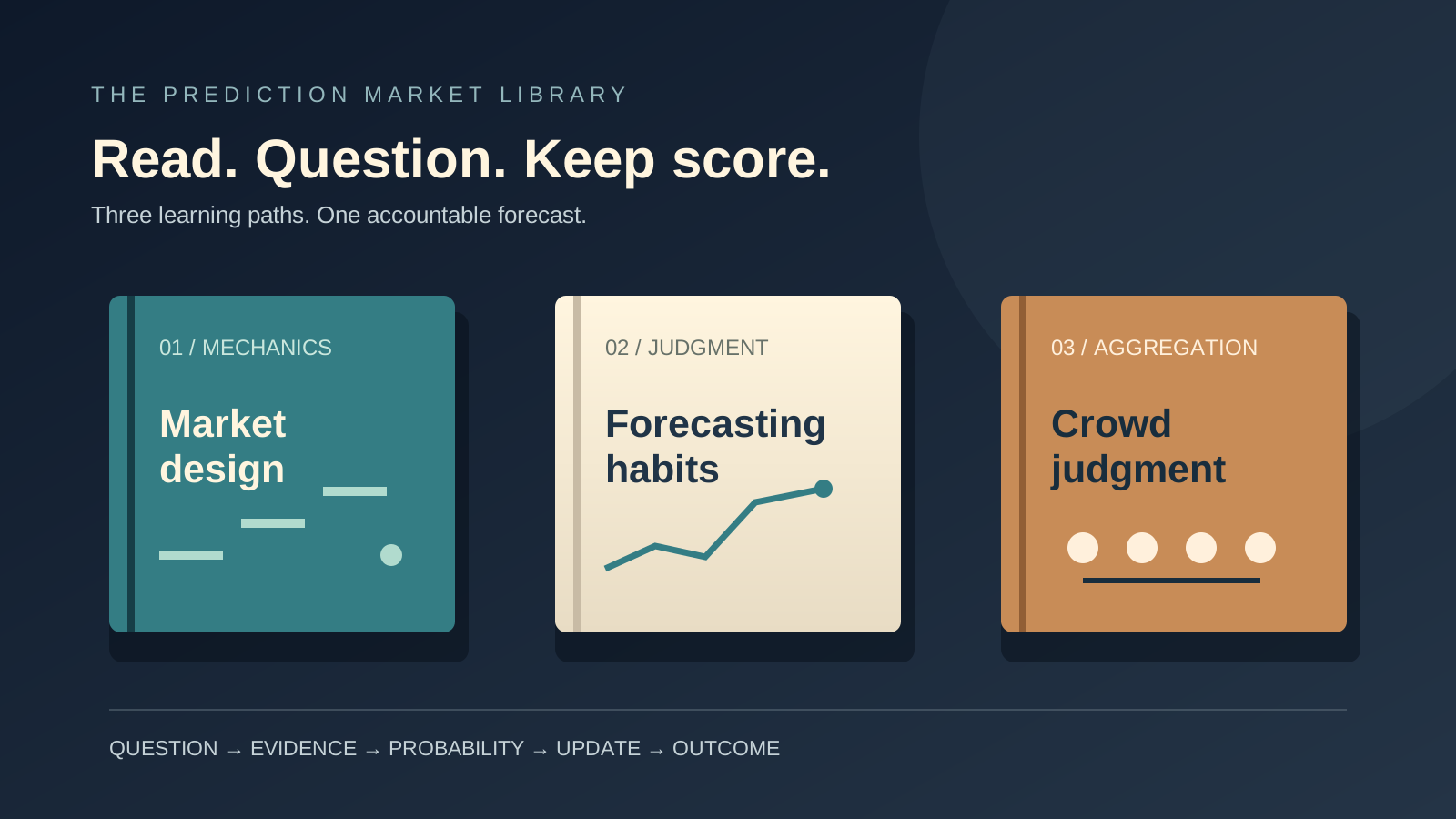
For books directly about prediction markets, start with Prediction Markets: Theory and Applications, edited by Leighton Vaughan Williams. For building your own forecasting habits, consider Superforecasting. For the broader idea of collective judgment, consider James Surowiecki’s The Wisdom of Crowds.
These resources answer different questions. A book about estimating probabilities does not teach a venue’s current order rules, and a market-design collection is not a shortcut to profitable trading. This guide connects each resource to a learning goal, with publisher links and a separate free academic paper.
How we selected them: We checked official publisher descriptions and the market-theory book’s contents on October 6, 2026. The recommendations reflect those stated topics and our suggested learning path; this is not a claim that we read and reviewed every book in full. We do not assign invented review scores. Publication dates, prices and availability vary by edition, format and country.
Choose a book by the question you want to answer
| Learning question | Resource | Scope |
|---|---|---|
| How do prediction markets collect information? | Prediction Markets: Theory and Applications | Edited collection about market mechanisms, design and applications |
| How can I make and revise probability forecasts? | Superforecasting | Forecasting research and habits |
| Why might a group’s judgment be useful? | The Wisdom of Crowds, by James Surowiecki | Collective intelligence across several fields |
| Can I start with a free academic overview? | Prediction Markets, by Wolfers and Zitzewitz | Research paper, listed separately below |
If you are new to the mechanics, first read our prediction-market odds guide. Understanding the outcome, contract payout and price makes the research questions easier to follow.
Prediction Markets: Theory and Applications
Edited by Leighton Vaughan Williams · Routledge · first edition. The publisher’s catalog describes a collection of contributions about using markets to aggregate information and forecast uncertain outcomes. Its listed contents cover mechanisms, contract design, business forecasting and applications in several settings.
This is our most direct match for readers searching for books on prediction markets themselves. Use it when your question is about how a market is constructed or why a price might contain information. The contents provide a way to select a relevant chapter rather than treating every application as the same problem.
Our suggested reading question: What assumptions connect the information participants hold to the number the market displays? Write down the contract, participant incentives and interpretation of the output before comparing it with another forecasting method.
Boundary: A foundational collection is not documentation for today’s Polymarket or Kalshi interface, APIs, fees or eligibility. Pair the theory with the selected venue’s current rules.
Superforecasting
Philip E. Tetlock and Dan Gardner. The official publisher description connects the book to forecasting-tournament research and the Good Judgment Project. It highlights varied evidence, probabilistic thinking, teamwork, keeping score and revising beliefs.
Our suggested use is to improve how you record and update forecasts. Before you look at a market, write down your estimate and the evidence behind it. After reading conflicting information, explain what changed and why. This turns a vague impression into something you can later evaluate.
Boundary: Better forecasting habits do not establish a trading edge. A probability estimate still needs to be compared with an executable price, costs and the exact settlement rule. The book’s research context is also not a fresh backtest of your current market selections.
The Wisdom of Crowds
James Surowiecki. The publisher describes this nonfiction book as an exploration of group judgment, with examples spanning economics, psychology and other fields. Verify the author when searching: this guide refers to Surowiecki’s nonfiction title.
Our suggested use is to broaden the question beyond a single forecaster. When you see agreement among commentators, ask whether those opinions contain separate observations or repeat one original report. The number of people sharing a claim does not tell you how many independent sources support it.
Boundary: A discussion of collective intelligence does not establish that every market price is accurate. Keep an evidence checklist alongside the crowd’s view, especially when a contract’s wording differs from the headline everyone is discussing.
A free research paper to read alongside the books
“Prediction Markets,” Justin Wolfers and Eric Zitzewitz, Journal of Economic Perspectives 18(2), Spring 2004, pages 107–126. This is a paper, not a fourth book. The American Economic Association article page offers a complimentary full-text PDF.
The abstract examines information aggregation, forecasting performance and market design. It distinguishes the expectations different contracts can reveal and flags the difficulty of separating correlation from causation in conditional markets.
Use it as a compact introduction to the academic questions. Its historical findings are not evidence that any particular current contract, platform or trading strategy will outperform a benchmark.
A reading order you can adapt
- Start with your question. Choose the forecasting book for personal estimation habits, the edited collection for market design, or the crowd book for collective judgment.
- Add the free paper. Compare the research question with the claims you see about present-day markets.
- Keep one forecast journal. Save your estimates before outcomes become known.
- Evaluate the record. Use the same observation rule and include misses as well as successes.
This order is an editorial suggestion, not a tested curriculum. You do not need to buy every title before practicing. A library copy, a publisher sample where available, and the free paper can help you decide which topic warrants deeper reading.
Turn reading into a forecast journal
Here is a template you can copy into a spreadsheet. It works without depositing money or placing an order.
| Journal field | What to save |
|---|---|
| Question | Exact event, deadline and resolution rule |
| Initial forecast | Probability and timestamp, recorded before the outcome |
| Evidence | Primary source links and the observation each supports |
| Update | New probability, new information and reason for the change |
| Outcome | Resolved result and any ambiguous or canceled case |
| Evaluation | Score under your predefined sampling rule |
For example, a fictional 70% forecast for an event that occurs has a binary Brier score of (0.70 − 1)² = 0.09. If it does not occur, the score is (0.70 − 0)² = 0.49. Lower is better, but one outcome cannot establish long-run calibration. Try the Brier score calculator with a consistently selected set of forecasts.
Our guide to evaluating Polymarket accuracy explains sample selection and forecast horizons. For venue-specific mechanics, the order-book guide explains why a displayed number can differ from a price available for your intended size.
Use Alphascope to organize prediction-market research, then keep your assumptions and evaluation record visible. The useful result of reading is a clearer question and a more accountable forecast, not a promise of profit.