
On this page
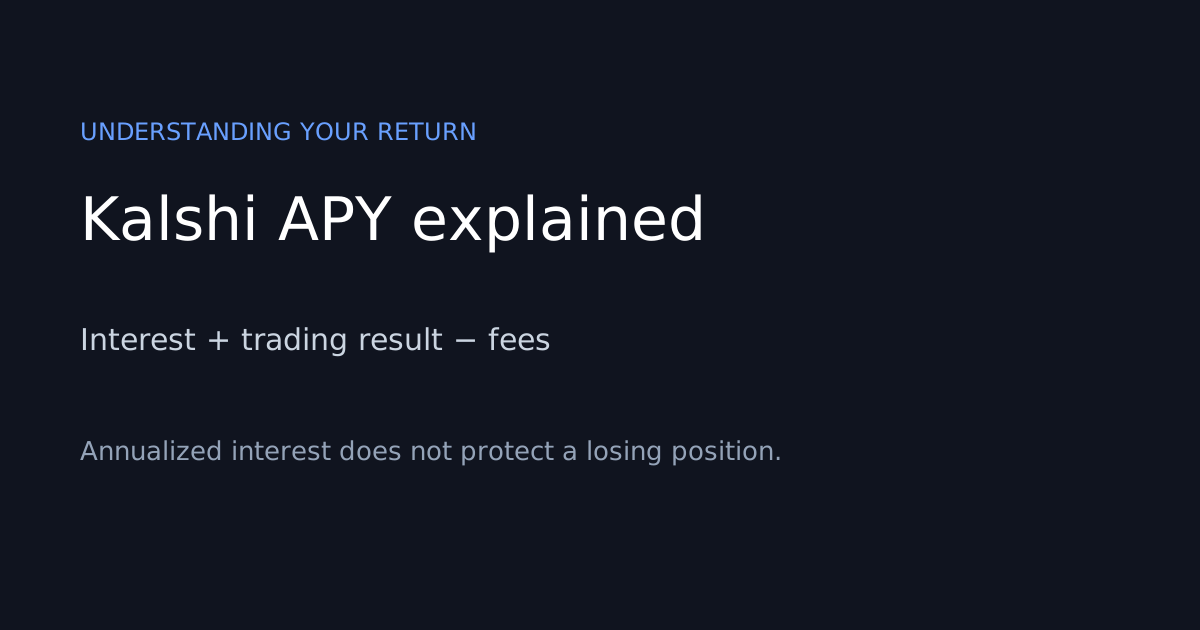
Kalshi APY describes annualized interest, not the return promised by a contract. A position can earn interest while losing trading value. Read the two numbers separately when reviewing your account.
Reviewed November 8, 2026. Kalshi’s dedicated APY help page lists a variable 3.50% prediction-market rate, a $250 average-monthly-balance requirement, daily accrual and monthly payment. It values the eligible portfolio at midnight Eastern, including cash and positions marked using last trades. Check your account’s current eligibility and terms.
What does APY mean over a shorter period?
APY is an annual measure. It does not mean you receive that percentage each month. For a hypothetical constant $1,000 balance at 3.50% APY for a full year, the annual gain would be $35 if the stated conditions and rate held throughout.
For a shorter illustrative period, the effective-rate formula is balance × ((1 + APY)^(days / 365) − 1). With $1,000, 3.50% and 30 days, it gives about $2.83. This is an illustration of annualization, not a reproduction of Kalshi’s account ledger or a forecast of your payout. Changing balances, eligibility and rate changes affect actual payments.
Interest and contract profit are different
Imagine a fictional account earns $3 in interest over a period but its positions lose $40 in value. Ignoring other cash flows and costs, the combined change is −$37. The interest did not protect the principal or make the trade profitable.
Keep three columns in your own record: interest credited, trading gains or losses, and fees. Record deposits and withdrawals separately so new funding does not look like investment performance. Our portfolio versus cash guide explains why displayed position value and withdrawable cash differ.
The separate perps program has separate conditions
The APY page also describes a conditional 7% perps-position program. It has qualifying-position, account-approval, open-interest, capacity, cap and termination conditions; cash does not automatically receive the headline rate. Read the complete live terms before relying on it.
Do not open leveraged exposure just to obtain a higher interest rate without evaluating the position’s downside. Interest math does not model liquidation, trading losses or funding costs. Our leverage guide explains the separate margin questions.
What to check when interest looks wrong
- Which account and program are you reviewing?
- Did the qualifying balance meet the rule over the relevant period?
- Are you comparing annualized interest with a monthly payment?
- Did positions or cash flows change during the period?
- Does the current dedicated APY page differ from an older help article?
General interest eligibility is limited to eligible US and territory users, and the APY page describes an SSN requirement for annual payments above $10. Provide sensitive information only through the official account flow.
Comparing exchange programs? Our ForecastEx guide explains broker access and incentive-coupon terms.
Keep a dated interest record
Save the rate, eligibility terms, dates, account category and credited payment when reconciling your balance. If the amount is unclear, ask support about the specific period and program rather than multiplying today’s rate by an earlier balance.
Alphascope provides forecast research and market-related news. It does not administer Kalshi’s interest program or verify an individual account’s eligibility.